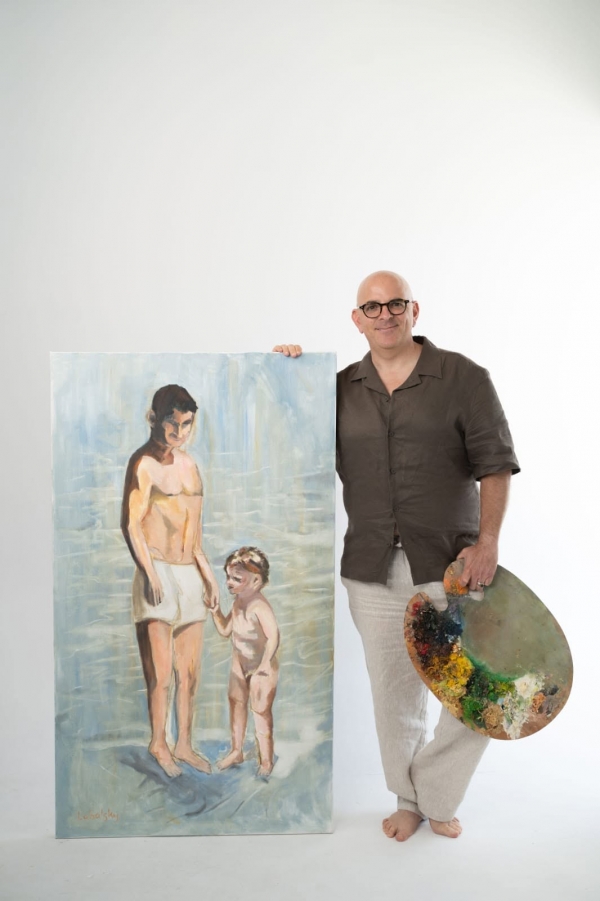
Who is Yosi Lubalsky within the realm of painting? Is he his father's child, or his own child's father?
This recurring and resonant question forms the opening point of Lubalsky's new exhibition, Not Everything Is Rosy, presenting a creative and personal journey that unfolds over eighteen years. What began as an exploration of fatherhood from the perspective of a father was interrupted by the course of life itself, lay dormant for years, and has only now been revived to reach its quiet and reconciled conclusion.
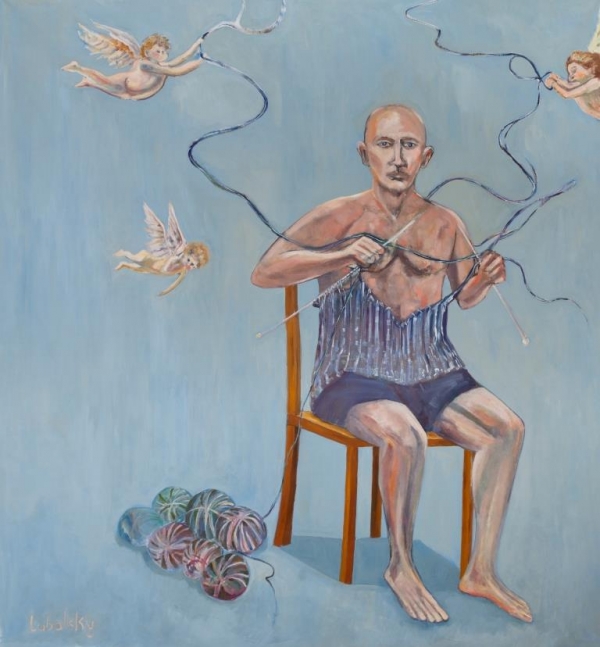
The exhibition's title, Not Everything Is Rosy, carries a dual meaning. On one hand, it reflects Lubalsky's dramatic artistic decision to abandon the rich, warm palette that has long been identified with his work in favor of a restrained spectrum of blues. On the other, it represents a direct confrontation with life's complexities, loss, and exposed emotions.
The sea functions here as both a visual and an emotional metaphor—an ocean of memories and enduring longing that continually deepens the relationship between son and father, and father and son. Within the paintings' compositions, the sea is not merely a passive backdrop; it is an active presence that envelops the figures, connects them, and grants each moment a sense of tranquility, compassion, and intimacy.
Alongside the large-scale oil paintings, the exhibition includes preparatory charcoal drawings, revealing the artist's earliest lines of thought—the emotional and structural framework upon which the finished works are built.
This contemplation of the father-son relationship acquires profound symbolic and emotional meaning through the background colors. The dialogue between ochre yellow, cobalt blue, and white creates a space suspended between earth and sky, human warmth and infinity, matter and spirit. Ochre evokes memory, rootedness, and warmth; cobalt blue opens the viewer's gaze toward the depths of both sea and soul; while white unifies them, introducing light, breath, and stillness. Together, this painterly palette carries the emotional weight of the work, intensifying its sense of intimacy and reconciliation.
At the heart of the exhibition, however, lies the transformation the artist himself underwent during the intervening years. Life continued, bringing with it the loss of both parents. Through this bereavement, Lubalsky discovered that orphanhood is not defined by age. Following their deaths, he embarked upon a new existential search—one that led to a profound shift in his identity on the canvas. The artist who began this series nearly two decades ago as a father observing his son now completes it as the child within the paintings—the orphaned son searching for his parents.
In the exhibition's central large-scale painting, Lubalsky seeks to reconnect with his mother through the act of knitting. The painting becomes a metaphor for life itself. On one hand, a person quietly knits together the sweater of a lifetime, weaving memories and experiences into its fabric. Yet on the other hand, unraveling is always inevitable.
Not Everything Is Rosy is ultimately a moment of wholeness and acceptance—an open invitation to contemplate the threads of family life as they unravel and are woven anew within a vast blue ocean of parting and consolation.
Exhibition Curator: Ilana Carmeli Lanner